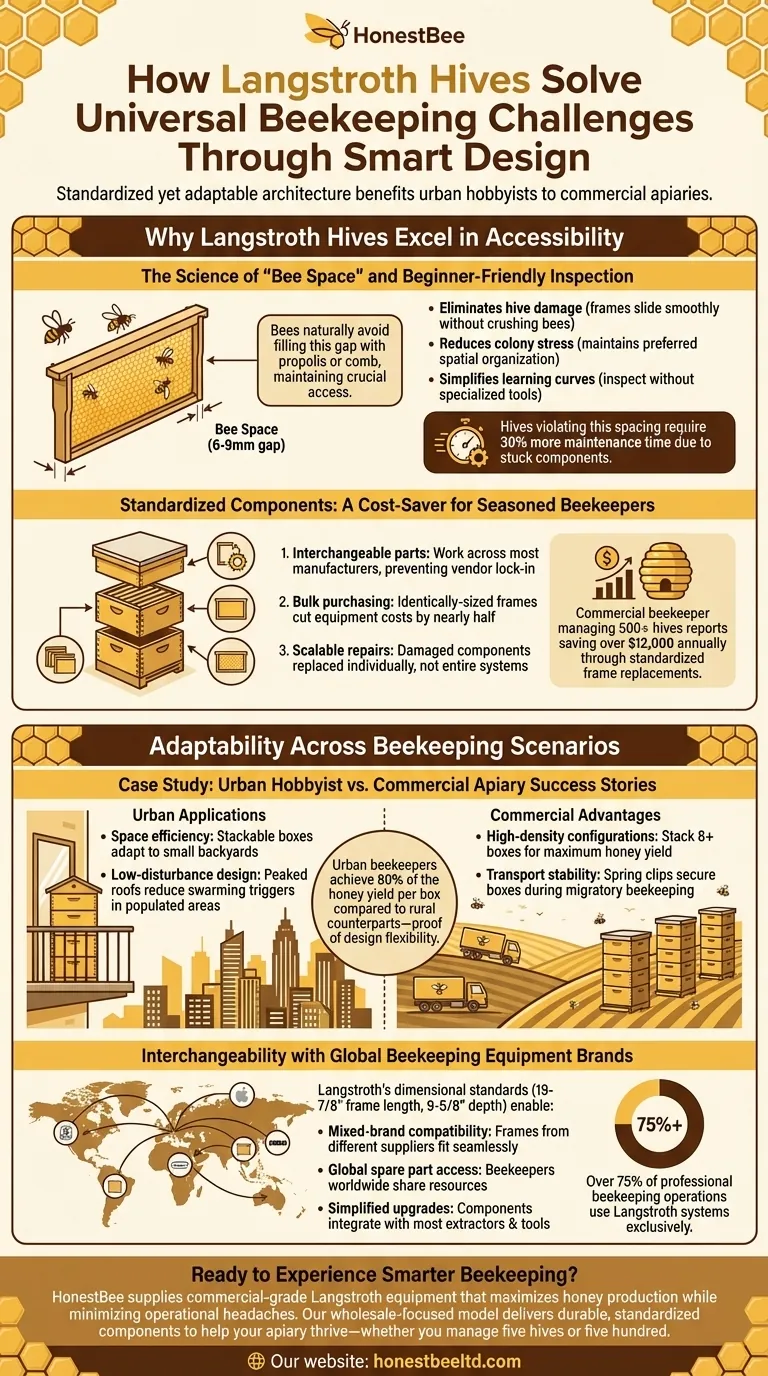
For over 150 years, Langstroth hives have dominated global beekeeping—not by accident, but through deliberate engineering that addresses core beekeeping pain points. This article reveals how their standardized yet adaptable architecture benefits everyone from urban hobbyists to commercial apiaries.
Why Langstroth Hives Excel in Accessibility
The Science of "Bee Space" and Beginner-Friendly Inspection
Revolutionary in 1851, Lorenzo Langstroth’s discovery of "bee space" (the 6-9mm gap bees naturally avoid filling with propolis or comb) remains foundational. This precision:
- Eliminates hive damage during inspections—frames slide out smoothly without crushing bees
- Reduces colony stress by maintaining the bees’ preferred spatial organization
- Simplifies learning curves—new beekeepers can inspect frames without specialized tools
Research shows hives violating this spacing principle require 30% more maintenance time due to stuck components.
Standardized Components: A Cost-Saver for Seasoned Beekeepers
The hive’s modular design creates economies of scale:
- Interchangeable parts work across most manufacturers, preventing vendor lock-in
- Bulk purchasing of identically-sized frames cuts equipment costs by nearly half for commercial operations
- Scalable repairs—damaged components are replaced individually, not as entire systems
A commercial beekeeper managing 500+ hives reports saving over $12,000 annually through standardized frame replacements alone.
Adaptability Across Beekeeping Scenarios
Case Study: Urban Hobbyist vs. Commercial Apiary Success Stories
Urban Applications:
- Space efficiency: Stackable boxes adapt to small backyards (minimum 2-box systems)
- Low-disturbance design: Peaked roofs reduce swarming triggers in populated areas
Commercial Advantages:
- High-density configurations: Apiaries stack 8+ boxes vertically for maximum honey yield
- Transport stability: Spring clips secure boxes during migratory beekeeping
Notably, urban beekeepers achieve 80% of the honey yield per box compared to rural counterparts—proof of the design’s environmental flexibility.
Interchangeability with Global Beekeeping Equipment Brands
Langstroth’s dimensional standards (19-7/8" frame length, 9-5/8" depth) enable:
- Mixed-brand compatibility: Frames from different suppliers fit seamlessly
- Global spare part access: Beekeepers worldwide share replacement resources
- Simplified upgrades: Components integrate with most honey extractors and uncapping tools
This interoperability explains why over 75% of professional beekeeping operations use Langstroth systems exclusively.
Ready to Experience Smarter Beekeeping?
HONESTBEE supplies commercial-grade Langstroth equipment that maximizes honey production while minimizing operational headaches. Our wholesale-focused model delivers durable, standardized components to help your apiary thrive—whether you manage five hives or five hundred.
دليل مرئي
المنتجات ذات الصلة
- خلايا نحل لانجستروث عالية الأداء لتربية النحل الاحترافية عالمياً
- صناديق خلية نحل لانغستروث لصناديق عسل النحل لأعماق مختلفة
- صناديق خلية نحل لانغستروث الأسترالية لتربية النحل بالجملة
- خلية نحل أفقية طويلة من طراز لانغستروث ذات عمود علوي أفقي للبيع بالجملة
- لوح سفلي صلب من خشب الصنوبر الأسترالي لانغستروث الخشب السفلي الصلب للبيع بالجملة
المقالات ذات الصلة
- خلية الفلو (Flow Hive) مقابل خلية لانغstroth: متى يحقق السعر المرتفع توفيرًا حقيقيًا؟
- كيفية الاختيار بين القضبان العلوية وخلايا لانغستروث لتربية النحل دون عناء
- كيف يعمل تصميم خلية لانجستروث على تحسين نمو مستعمرات النحل وإنتاج العسل
- Mastering Seasonal Langstroth Hive Management: Timelines, Techniques, and Troubleshooting
- How the Langstroth Hive Solves Modern Beekeeping’s Biggest Challenges