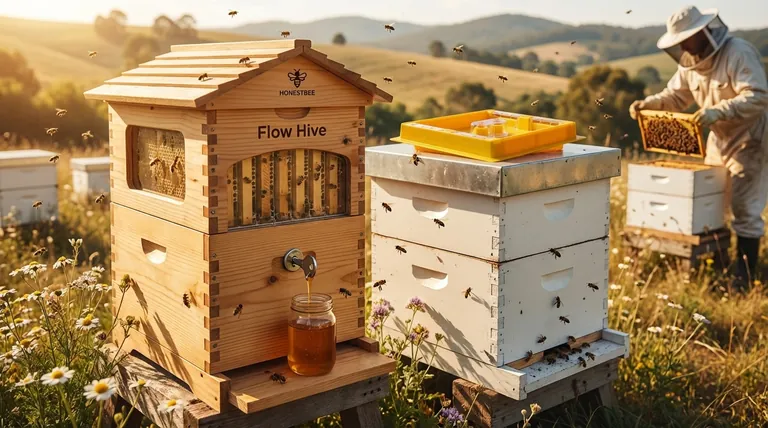
Choosing the right beehive system impacts your bees’ health, your budget, and your honey yield. This guide compares Flow Hives and Langstroth hives across three critical dimensions: bee welfare, cost efficiency, and long-term productivity, helping you make an informed decision.
Understanding Beekeeping Systems
Extraction Methods and Bee Disruption
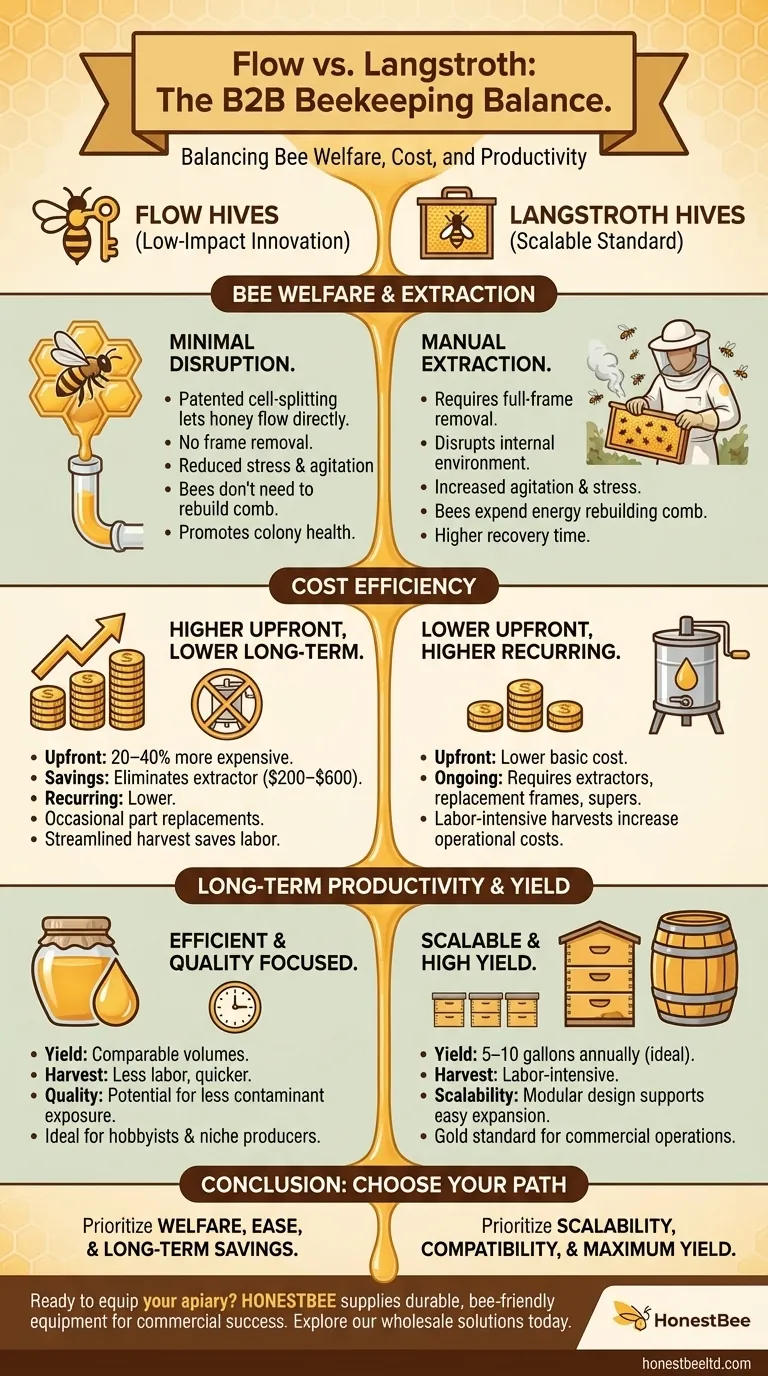
Flow Hives minimize bee disturbance during harvest. Their patented cell-splitting mechanism lets honey flow through tubes when a key is turned, eliminating the need to remove frames or use extractors. Research shows this reduces stress on colonies, as bees don’t need to rebuild comb after harvest.
Langstroth hives, while effective, require full-frame removal and manual extraction. This process disrupts the hive’s internal environment and forces bees to redirect energy toward comb reconstruction. For beekeepers prioritizing low-impact harvesting, Flow Hives offer a clear advantage.
Equipment Costs and Maintenance Demands
- Upfront Costs: Flow Hives are typically 20–40% more expensive than basic Langstroth setups due to their specialized frames. However, they eliminate the need for extractors (a $200–$600 savings).
- Recurring Costs: Langstroth systems require ongoing investments in extraction equipment, replacement frames, and supers. Flow Hives reduce these costs but may need occasional part replacements.
For budget-conscious beekeepers, Langstroth hives are cheaper initially, but Flow Hives can save money long-term by streamlining harvests.
Long-Term Impacts on Colonies
Stress Indicators in Honeybees
Bees in Langstroth hives exhibit higher stress during inspections and harvests, evidenced by increased agitation and slower post-harvest recovery. In contrast, Flow Hives reduce these stressors by limiting hive openings.
Did you know? Bees expend significant energy rebuilding comb after traditional harvests—energy that could otherwise support colony growth or honey production.
Honey Yield and Quality Comparisons
- Langstroth hives yield 5–10 gallons annually, ideal for commercial operations.
- Flow Hives produce comparable volumes but with less labor. Their design may also preserve honey quality by minimizing exposure to contaminants during extraction.
While both systems deliver solid yields, Flow Hives excel in efficiency, while Langstroth hives remain the gold standard for scalability.
Practical Considerations for Beekeepers
Scalability for Hobbyists vs. Commercial Use
- Hobbyists: Flow Hives simplify small-scale beekeeping with minimal equipment.
- Commercial Operations: Langstroth hives’ modular design supports easier expansion, though they demand more labor.
Environmental and Ethical Trade-offs
Flow Hives align with low-impact beekeeping by reducing habitat disruption. However, Langstroth systems are more adaptable to organic practices (e.g., natural comb building).
Conclusion: Which Hive Is Right for You?
- Choose a Flow Hive if you prioritize bee welfare, ease of harvest, and long-term cost savings.
- Opt for a Langstroth hive if you need scalability, compatibility with standard equipment, or higher honey yields.
Ready to equip your apiary? HONESTBEE supplies commercial beekeepers and distributors with durable, bee-friendly equipment—ensuring your colonies thrive while maximizing productivity. [Explore our wholesale solutions today.]
دليل مرئي
المنتجات ذات الصلة
- خلايا نحل خشبية بحجم دادانت لتربية النحل
- فتحات تهوية مستديرة من الفولاذ المقاوم للصدأ للتهوية
- حامل خلية نحل معدني حامل صندوق نحل لتربية النحل
- مجموعة أرقام الخلايا البلاستيكية المتينة لتربية النحل
- إطارات خلايا النحل الخشبية لتربية النحل والبيع بالجملة
المقالات ذات الصلة
- ما وراء صندوق النحل: لماذا يحدد استثمارك الأول في المنحل نجاحك
- القاتل الصامت في الخلية: لماذا الرطوبة، وليس البرد، هي أكبر تهديد للشتاء
- كيفية تجميع خلايا النحل الخشبية: دليل المبتدئين لأنظمة الوصلات المتينة
- لماذا تتفوق خلايا النحل الخشبية على البدائل الحديثة: دليل مدعوم علمياً لمربي النحل
- كيف تحدد مساحة النحل نجاح الخلية: استراتيجيات إدارة مدعومة بالعلم